Californians reject billionaire tax, voter ID requirement
Regional News

Audio By Carbonatix
11:00 PM on Tuesday, November 3
Madeline Shannon
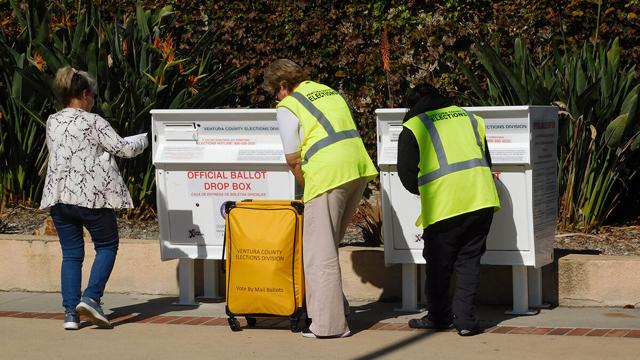
(The Center Square) – Proposals for a billionaire tax and a voter ID requirement both failed in California's election Tuesday.
As of 10:12 p.m. Pacific time on Tuesday, 68.5% of precincts in California were partially reporting their election results.
Prop. 40, commonly referred to as the billionaire tax, stood at 56.5% against to 43.5% in support, failing at the ballot box, with 3,458,132 against the wealth tax and 2,662,682 for it. The measure aimed to impose a one-time 5% tax on California residents whose wealth is valued at $1 billion or more. The tax would apply to wealth that includes assets like stocks, collectibles and artwork, according to previous reporting by The Center Square.
The money generated from that ballot measure is projected to be about $100 billion worth of revenue over five years and would primarily be used to offset federal budget cuts to taxpayer-funded health care programs like Medicaid, known as Medi-Cal in California.
However, another measure on the November ballot, Prop. 42, would cancel out that tax if the wealth tax had passed. Prop. 42 would ban new taxes imposed by the state on personal property. If California voters had ultimately voted in favor of both Prop. 40 and Prop. 42, whichever proposition garners the most votes would win and the other will be effectively nullified.
Prop. 42 was passing with 3,314,411, or 54.6% of voters for the measure, and 2,759,502, or 45.4% of voters against it.
Other propositions on the November ballot in California include Prop. 39, which sought to establish voter identification requirements. California voters opted to reject that proposition 59.7% to 40.3%, or 3,648,592 against the measure and 2,466,396 in support.
Several bond measures were on the November ballot. Prop. 1 proposed $11.25 billion to pay for affordable housing projects for the homeless, students and veterans. The proposition would cost California’s taxpayers $500 million to $600 million every year for 25 years to pay back the bond debt. Prop. 37 authorizes $25 billion worth of bonds to be used for fixed-rate mortgages for homebuyers in the state, and the bond debt would be repaid by mortgage payments paid by homeowners who qualify for the home buying assistance program established by this ballot measure.
Prop. 1 was passing 59.4% to 40.6%, garnering 3,580,591 votes in support with 2,451,843 votes against. Meanwhile, Prop. 37 was passing with 60.9% of the vote compared to 39.1% of voters who rejected the proposition, roughly 3,656,056 in support and 2,346,619 against.
Another bond measure, Prop. 38, authorizes $8.4 billion in taxpayer-backed bonds to pay for immunology and immunotherapy research. Half of the money would go to a medical research institute affiliated with the University of California and the other half of the bond money would go to research grants, according to the voter guide. Prop. 38 was passing with 57% of the vote with 43% rejecting the measure, showing 3,434,252 voters supporting the bond measure and 2,591,202 against it.
Other tax-related ballot measures Californians are deciding include Prop. 2, which increases the state’s “Rainy Day Fund.” This is essentially the state government’s savings account and would increase from 10% to 20% of general fund revenues if Californians vote to pass Prop. 2. The money would be used to pay for taxpayer-funded education, health care, public safety and other essential services when the economy takes a nosedive. That ballot measure was passing 60% to 40%, with 3,616,860 for the measure and 2,410,974 against.
Prop. 3 would extend a tax on Californians who make more than $371,000 annually to help pay for public education, according to the voter guide. The tax would maintain $5 billion to $15 billion of taxpayer funds instead of letting the already-existing tax expire in 2031. Prop. 3 was passing 58.9% to 41.1%, with 3,576,516 voters supporting the proposition and 2,500,435 against.
Prop. 4 aimed to repeal a ban on using public funds for political campaign-related expenses, although those taxpayer dollars can’t be taken away from education, transportation or public safety, according to the voter guide. That proposition was failing, with 52.1% of voters against it and 47.9% supporting it, pitting roughly 3,101,601 voters who rejected the measure against the 2,856,680 who supported it.
Prop. 41 nullifies state taxes enacted after Jan. 1, 2026 that generate more revenue for the state than what is allowed under the Gann Limit. This constitutionally-imposed limit curtails what the state Legislature can spend in its annual budget. If Prop. 41 passes, any new statewide taxes that exempt their revenues from the Gann Limit would be prohibited.
That measure was failing 52.5% to 47.5%, with 3,156,075 of voters rejecting it versus 2,860,842 supporting.
Another tax measure, Prop. 43, limits the ability of California’s voters to approve voter-proposed local taxes by increasing the number of votes needed to pass such a local tax. If this measure passes, local taxes would need a two-thirds vote in support to be able to pass starting on Jan. 1, 2027. Prop. 43 was failing 54.7%, or 3,274,180 rejecting it, versus 45.3%, or 2,712,508 voters supporting it.
Prop. 45 was failing early Tuesday evening, with 3,239,196 voters, or 45.5%, rejecting the measure, with 2,720,187, or 45.6%, in support. Prop. 44 had 82.6% of voters against it – roughly 4,936,859 – to 17.4%, or 1,040,999 voters, in support.
Prop. 5 would require a special election or appointment to fill vacant political offices after a successful recall election. Prop. 5 was passing late Tuesday, with 50.4% of voters supporting it – 2,956,917 in total – while 49.6% of voters rejected it, totaling 2,904,616.
Voters on Tuesday rejected Prop. 44, which seeks to impose penalties on federal taxpayer-funded health clinics that provide medical care to disadvantaged populations and Prop. 45, which expedites environmental review for housing, transportation and water projects.