Suffering for Doing Good (Part 2 of 2)
Ministries > Truth For Life with Alistair Begg
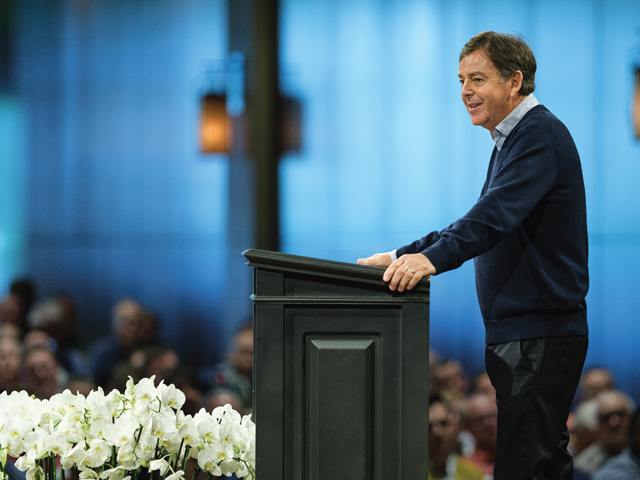
 The apostle Peter wrote to remind Christ’s followers of the importance of standing firm in God’s grace when we face opposition. What speaks louder in conflict than a strong argument? Find out as you study along with us on Truth For Life with Alistair Begg.
-----------------------------------------
• Click here and look for "FROM THE SERMON" to stream or read the full message.
• This program is part of the series ‘The Stranger’s Hope’
• Learn more about our current resource, request your copy with a donation of any amount.
Helpful Resources
- Learn about God's salvation plan
- Read our most recent articles
- Subscribe to our daily devotional
Follow Us
YouTube | Instagram | Facebook | X
This listener-funded program features the clear, relevant Bible teaching of Alistair Begg. Today’s program and nearly 3,000 messages can be streamed and shared for free at tfl.org thanks to the generous giving from monthly donors called Truthpartners. Learn more about this Gospel-sharing team or become one today. Thanks for listening to Truth For Life!
Bob Lapine: The Apostle Peter wrote to remind Jesus' followers of the importance of standing firm in God's grace when we face opposition. But how do we do that? Today on Truth For Life, we'll learn what speaks even louder than a strong argument. Alistair Begg is teaching from 1 Peter chapter 3. He begins today at verse 8.
Alistair Begg: Now, what do we say to our teenagers and our young people? Even if you should suffer for righteousness' sake, you will be blessed. Well, how would they be suffering for righteousness' sake? Well, in the present generation, if you're prepared to honor your father and your mother, actually obey them, come home when they say, live under their tutelage and loving care, you may actually be ridiculed by your friends. If you, as a young student today, are committed to moral purity before marriage and in marriage, the chances are that you're going to be maligned for righteousness' sake. If you are committed to being a truth teller in a world of shifting values, in a world of people who have made a skill in telling lies to one another, you may become the occasion of animosity. Now, you don't have to be a teenager. In company outings, corporate outings, Christmas parties, social gatherings, they may hate you, but you will be blessed. In most cases, the response of the culture to even expressions that are fairly minor concerning Jesus is at least irritation, often opposition, and on many occasions, just flat-out rejection. Years ago, I had the privilege of speaking at a corporate gathering, and it was a long time ago, for Chrysler Corporation in America. They gave awards to students, and for some reason, I had been invited to give a talk to them. They were receiving awards because they'd been good students, and it was within the context of corporate culture. However, I used the opportunity to provide the story of the man who built his house on the rock versus the man who built his house on the sand. And nobody said anything to me, in terms of the leadership of the thing when I got in my car to go home. But later, the only report I had was, the Begg fellow gave a very good talk, but we would like a lot less of Jesus if he comes again. A lot less of Jesus. See, Jesus was the problem. Spirituality's not the problem. Religion's not the problem. Jesus is the problem. And when we do what Jesus says, when we trace our lives against the Spirit-endued framework of all that he desires for us, then we will be blessed, because Jesus promised that. Blessed are those who are persecuted for righteousness’ sake. Not persecuted for being a jolly nuisance in your office. That's easy. No, persecuted for righteousness' sake, for theirs is the kingdom of heaven. Now, let's be honest, most of us know very little about persecution. suffering is an area of spiritual geography that we have to really try hard in order to say, "Oh yes, I get this." Some have paid the ultimate price. As I was thinking about this again this morning, I was reminded of the fact that when I was at the equivalent of Moore College in London, that's a reach, but anyway, when I was there, that's trying to pull myself up rather than pull you folks down. Anyway, myself and a friend, along with a young lady, were sent to the London Embankment Mission. The London Embankment Mission is full of people who are living on the embankments and around the streets of London. They bring them in, they offer them pizza, and they hold that out as a reward for having to listen to dreadful talks from the Bible given by people that they bring in, namely myself and my friend Steve. We’d never experienced anything like it. The lady who was with us was a singer. She had a beautiful voice. Her name was Mary Fisher. She was Welsh. And I have such a vivid recollection of it because when Steve was speaking, a gentleman, one of the people from the street, got out a newspaper. The entire newspaper, he opened it out like that, in front of his face. And so Steve is here, the man is there, and the newspaper is there. And I remember sitting thinking smugly to myself, oh, Steve is not doing very well, you know. No, this is not what you would call coming across. And, but next it was my turn. Oh, it wasn't the same fellow, it was one of his pals, but he took it up a notch. He went in his coat and he brought out a gigantic alarm clock, one of those, one that has the bells on the top, and he set it and made it ring like about one minute later. The only time there was silence in the room or attention was to the lilting voice of Mary Fisher, a mathematics and science teacher who trained at LBC because, like many here, had felt the call of God to world missions. She was working with a mutual friend from Rhodesia, from Zimbabwe, Obert Merwira, who was helping her to prepare for the Shona language in order that she could instruct. And off she went to do that. You can find this just by Googling it. She was a couple of years ahead of me, and she went off to do exactly what she'd planned to do. And on the 23rd of June 1978, when the Zimbabwean guerrillas attacked the Pentecostal school, she and a number of others passed into eternity. When her belongings were brought back to home, cassette tapes in that time. The people who began to play the cassette tapes found that one of the songs that she'd been teaching to the young children in the school, sung in Shona, obviously, was the song, For me to live is Christ and to die is gain, to hold his hand and walk his narrow way. There is no peace, no joy, no thrill, like walking in his will, for me to live is Christ and to die is gain. She was thirty-one when Jesus took her home. Peter is not writing in abstraction here. Have no fear of them, he says, nor be troubled. Surely there are a number of lines in this letter, as I've already said, that must have caused Peter to write, “Have no fear of them or be troubled.” Really, Peter? You mean, like, you didn't have fear of those people who were asking you the questions about whether you followed Jesus or loved Jesus or knew Jesus? Like, when you didn't have any fear when the lady says, "Surely you are one of his." And on the third occasion, with fearful oaths, you said, "No, I'm not a disciple of Jesus. I don't know Jesus." Now, it is this same Peter who is giving instructions: "Have no fear of them, nor be troubled. In your hearts honor Christ as holy, always prepared to make a defense to anyone who asks you. In other words, as you face this suffering and as you respond according to God’s plan, then it will be an occasion for people to say, “Why is it that you have responded in that way? Can you tell me why it is that despite the fact that you’re going through this, instead of you reviling, becoming spiteful, or whatever it might be, there’s a dimension to you that I don’t understand. Can you please help me understand? Well, Peter says you've got to be ready with an answer. Well, Peter was ready with an answer. It was the wrong answer. And now he says, don't be like me. Peter in the courtyard, in face of all the trials, and now us in face of trials and opposition, when enabled by grace, we end up not fearing our opponents, we cause them to be surprised, and so on. The setting may be a courthouse, it may be a common room, it may be a lab, it may be a golf course, whatever it might be. But Peter says, “Make sure you do this.” Maybe just another pause. What about the times when we have floundered in the equivalent of the courtyard? What about the times when we have bottled it when the opportunity was so clearly there to speak a word concerning Jesus? Well, we ought to be encouraged by Peter’s example, not in terms of his collapsing like a broken deck chair, but that the fact is that in the economy of God, that's not the end of the story of Peter. If it were the end of the story of Peter, we wouldn't be reading his letter here this morning. Because the collapse in the courtyard is more than offset by the barbecue on the beach, with the Lord of glory providing breakfast and restoring him and fulfilling the promise that he's made to him. Listen, you fellas, Satan has desired to sift you like wheat, but I have prayed for you. You, Peter. And when everything is put back in order, you go ahead and strengthen the brethren. From devastation to restoration. This is the God we serve. The Christian life is a series of new beginnings. Somebody might be listening to my words right now, and in a way that nobody around you knows, you are burdened by a courtyard moment. And part of the reason that we're sitting under the instruction of the Word in multiple ways now is in order that we might have that experience of, if you like, the barbecue on the beach, because the God we serve is the God who's able to restore even the years that the locusts have eaten. And as he will actually go on to tell us before we finish, that God, the God of all grace, is the one who restores, who confirms, who strengthens, and who establishes you. Now, in seeking to do what he encourages us to do here, we recognize that if we're going to be able to give answers to people, we have to make sure that we understand that tone, if I can come back to tone again, really, really matters. In fact, the tone with which we respond to people will often have a greater impact than our ability to marshal our facts or even to explain our position. You will notice that there's a couple of ways you can go at this. Verse 16, with your conscience clear, even when you're slandered, even with those who revile you, make sure that your response is with gentleness and with respect, rather than with arrogance and self-assertion. Here is honorable conduct of verse 12 in chapter 2 brought to the fore. the witness to Christ involves our words and also our lives. And strong arguments will not actually be honoring to God or particularly helpful to anyone if they're not supported by a consistent life. Slander and reviling will be answered by our good behavior, even though, verse 17, even though it may be our good behavior that has provoked the animosity in the first place. It is still, he says, better to suffer for doing good, if that is what God has for us, than for doing evil. Now, he's going to go on and make it clear that we shouldn't be surprised by the suffering, but we need to learn to respond to it in the distinctively Christian fashion. The suffering should be undeserved. It will be, because God is sovereign, divinely ordained, and those factors are clear because they are there in the suffering of Jesus. We're at verse 18. You think I'm trying to go slow so that I can avoid the difficult part at the end. That's only partly true. Christ also suffered for sins. What do we know about this? Well, we know a number of things: that it was undeserved, undeserved, that he suffered in the place of those who deserve to suffer. He bears a punishment that others deserve in order that we might know a forgiveness that we don't deserve. It is a vicarious involvement. It is a substitutionary involvement. It is, at the same time, an unrepeatable act on the part of Jesus. Christ suffered once for sins, the righteous for the unrighteous, that he might bring us to God. It is therefore purposeful. The suffering is purposeful in order that those who are rebels against God might be made the friends of God. The story of Jesus as it is recounted here is the story of triumph and not of defeat. It is the story of an empty cross. It is the story of the victory over death and sin and the grave. And the story of Christian proclamation has to be just that. This morning, as I began to look at the news feed, I came on something you may have seen, and that is that the people at Fox News in America were all very excited, devoted about six minutes to their program to announcing the fact that in Apple’s figures, in terms of the most effective podcasts now at the beginning of 2025, number one is a Roman Catholic priest encouraging people to pray the rosary every day throughout the year. Now, I've got no comment on the Fox people and their motivation of what they're doing, but I do know about the rosary. Are you really asking me to say every day, Hail Mary, full of grace, the Lord is with you. Blessed art thou among women, and blessed is the fruit of thy womb, Jesus. Are you really asking me to say, Holy Mary, Mother of God, pray for me, a sinner, now and at the hour of our death. Because if you are, I need to tell you, Mary can't do any of that. She never could. We need the courage in these days, as gospel men and women seeking to introduce the world to Jesus, the courage to be Protestant, to be Protestant. Christ's sacrifice for sins was a once unrepeatable sacrifice for sin. Here is the constitution of the sacred in Vatican II. The Mass is at the same time and inseparably a sacrifice in which the sacrifice of the cross is perpetuated, for in it Christ perpetuates in an unbloody manner the sacrifice offered on the cross, offering himself to the Father for the world’s salvation through the ministry of priests. Our message is so far removed from that, because the triumph of Jesus is exactly that. The head that once was crowned with thorns is crowned with glory now. A royal diadem adorns the mighty Savior’s brow. He’s the resurrection and the life. Well, you say, yes, but what are we to make about all of the challenge of the remainder of the text? Are you really trying to stay away from that? No, no, no, no. But I'm assigning it for homework. And any lingering questions you have, the eminent faculty, both present and former, of Moore College is scattered around the building. And I've checked, and I believe that they have this under masterful Control. What are we to make of this? Well, just a number of things, in seriousness. presumably, what we read here was clear, or certainly was clearer, to the first readers. I hope so. Secondly, we recognize the danger of drowning in a variety of interpretations. Three, we're thankful for people like Martin Luther, who says of this, “A wonderful text this is, and a more obscure passage perhaps than any in the New Testament, so that I do not know for certainty just what Peter means.” Now, if he was around, I'd give him a big hug. The same kind of hug I want to give to John Calvin for never having given us a commentary on the book of Revelation. And I have it on good report. That is because he didn't fully understand it himself. That's worthy of another hug, if it's true. What do we have? The main things are the plain things, and the plain things are the main things. Jesus died. His earthly life ended, but that earthly life was succeeded by his heavenly life. In that life, subsequently, not before, pre-incarnately, not during, in between death and resurrection, but post-resurrection, I take it, that the spirits to which he proclaimed victory are those who had rebelled in Noah’s day. How does that work? At some point along the way, he confirmed his victory and their destiny. Now, it so happens that in the Murray McShane readings, we were reading Genesis 7 this morning, and there we had it. It was perfect timing. In Noah's day, God's patience finally runs out, and what do we discover? We discover that the water that destroyed the rest of the world was the means of salvation to Noah and his family, who were floating around in the ark. And just as the flood spoke of judgment, which those in the ark were both saved from and saved by in order to enjoy a new world, so the water of Christian baptism speaks of the death which fell upon Christ, a death due to sinners, which believers into Christ are both saved from and saved by, and through which they enter into the enjoyment of a new life before God. Now, we could say more than that, but we won't. Our salvation is portrayed in baptism; it is not performed by it. And when the first readers of this letter went for coffee with one another and said to each other, “Do you really get that thing about the ark and in and out and Noah and everything else?” Somebody said, “Well, I don't think I've got it all, but I do get this. I understand exactly who Jesus is. He is Savior, Lord, and King. I understand exactly this, that he has accomplished a once-for-all atoning sacrifice in order that those who trust in him might know forgiveness of sins and joy in the Holy Spirit. And I know also that not only who he is and what he's done, but where he is, because he has gone into heaven on our behalf. When Calvin finished his preaching, almost inevitably he prayed this prayer which I now pray. Now, let us cast ourselves down before the majesty of our good God, asking him to forgive our sin and renew us in the image of Christ, and to fulfill all his purposes in us and through us to the praise of his glory. Amen.
Bob Lapine: You're listening to Alistair Begg on Truth For Life. If you've missed any of the messages in our current series, you can catch up online. All of Alistair's teaching can be streamed for free through our mobile app or on our website at truthforlife.org. The series is titled The Stranger's Hope. In addition to the daily Bible teaching you hear on this program, we also carefully select books that will help you better understand scripture, and today we're recommending a book called The Incarnation in the Gospels. This book looks at the unique perspectives through which the gospel writers each tell the story of the birth of Jesus. The book is written by respected pastors and theologians Daniel Doreani, Philip Riken, and Richard Phillips. In just 12 scripture-centered readings, the authors take us through the accounts of the Christmas story found in Matthew, Luke, and John. They carefully highlight connections and insights that will enrich your understanding of the significance of the incarnation and the larger story of salvation. Ask for your copy of the book The Incarnation in the Gospels when you give a year-end donation today. You can give securely online at truthforlife.org/give, or you can speak to one of our customer service reps. Call 888-588-7884. And if you'd rather mail your year-end donation along with a request for the book, write to us at Truth For Life, PO Box 398000, Cleveland, Ohio 44139. Again, you can shop and donate at truthforlife.org/gifts or call us at 888-588-7884. I'm Bob Lapine. We are glad you studied the Bible with us today. Tomorrow we'll consider what it means to live under the shadow of the cross. The Bible teaching of Alistair Begg is furnished by Truth For Life, where the learning is for living.
Related Episodes
Stewards of God’s Varied Grace (Part 1 of 2)
Friday, November 20
Suffering for Doing Good (Part 1 of 2)
Wednesday, November 18
Honorable Conduct (Part 2 of 2)
Tuesday, November 17
About Truth For Life
Truth For Life distributes the unique, expositional Bible teaching of Alistair Begg. Studying God’s Word each day, verse by verse, is the hallmark of this ministry. In a desire to share the good news of the Gospel without cost as a barrier, the entire teaching archive is available for free download and resources are available at cost with no markup.
About Alistair Begg
Alistair Begg has been in pastoral ministry since 1975. Following graduation from The London School of Theology, he served eight years in Scotland at both Charlotte Chapel in Edinburgh and Hamilton Baptist Church. In 1983, he became the senior pastor at Parkside Church near Cleveland, Ohio. He has written several books and is heard daily and weekly on the radio program, Truth For Life. The teaching on Truth For Life stems from the week by week Bible teaching at Parkside Church. He and his wife, Susan, were married in 1975 and they have three grown children.Contact Truth For Life with Alistair Begg
Website
http://www.truthforlife.org/?utm_source=oneplace&utm_medium=sitelinks&utm_campaign=home
Mailing Address
Truth For Life
P.O. Box 398000
Cleveland OH 44139
Telephone (Customer Service)
888-588-7884 Domestic
400-543-6800 International
440-543-0522 ( Fax)